
6 Notes on Facilitation: Friction, Flow and Flourishing
Thought snacks on things I've learned, unlearned, relearned and am continuing to learn in my facilitation practice

In the spirit of Pagbubuo (and before I psych myself out of writing this because it needs to be "whole" and “just right/perfect”), I wanted to take some time to write about what I want to remember about facilitation since I started in 2013 (whether I knew it or not), and the accelerated “flourishing” of my facilitation practice in more recent years through my curiosity and growth in coaching, participatory research, and expressive arts. This is not an extensive list or article. This is just me going with where the flow takes me in the time that I have. Buo habang nagbubuo.
I also share a list of upcoming gatherings I’m facilitating at the end of this post.
I like thinking of things in three parts.
Growth (pagsibol). Decay (pagbulok). Evolution (pagbago).
Pagbubungkal (tilling). Pagbibinhi (seeding). Pagbuburo (fermenting/composting).
Lupa (grounding). Likha (creating). Linang (cultivating).
Flow. Friction. Flourishing.
Learning. Unlearning. Relearning.
And so this is the frame with which I organize some insights I’ve gained from my most recent experiences: the Ecosystem Leadership program I joined last June, and my year-long Expressive Arts facilitation journey; while also reflecting on how those relate to my prior experiences with Haraya Coaching, Muni, and current experiences with Good Food Community.
I. Pagbubungkal
In the recent Kusina, Kalsada, Kapwa (KKK) gathering held by Good Food Community, one participant in my group (Krishna) shared about the need for pagbubungkal, or in a way, to unearth, unlearn, to “disturb the soil” when we think about the changes we want to see in wider society. “Hindi frictionless ang relationship-building,” (Relationship-building is not frictionless) said KKK organizer Mabi David when talking about growing a community.
Hindi frictionless ang pagbabago.
There is no growth without discomfort.
We start with dissonance
— the gaps.
We don’t just accept
— we challenge
the mindsets and beliefs of others
as well as our own.
Here are a couple of things I’m unlearning in my practice of facilitation.
1. “It’s not a straight jacket.”
I first heard this from awareness-based systems researcher Megan Seneque at the Ecosystem Leadership program I attended last June, when she was referring to the Theory U1 models and frameworks we were discussing, and it really stuck with me.
I was initially wary about going into the space because I worried that it may have had culty vibes, with Otto Scharmer as their leader. But when Megan said that, I felt that the work was really alive and evolving, not a static framework to be immortalized.
All models are wrong. Some are useful.
- George Box, British statistician
In the training, development and management consultancy space, and in the academe, we like our frameworks and models. And it seems like there is usually a goal to either reference existing frameworks, or to develop new or adapted ones.
As a models and frameworks girlie, I love chewing on different frameworks, and I found it motivating to create one for my Masters dissertation2 on motivations of sustainability leadership, and for my “flourishing framework” for a coaching journey3.
However, Megan’s statement reminds me not to be too so enamored with a framework that we don’t recognize when it has a become a captor or when we have become a prisoner to its regime. Ack!
2. Time and tears as metrics of success
I used to think that excellent facilitation meant being able to design programs and workshops with precision — being able to stick to a clearly defined schedule.
I also used to think that the more tears were shed in a session, the more impactful it was.
And don’t get me wrong — being able to start and end on time, and creating an impactful experience for my participants is still important to me, but I don’t measure it with the same stick anymore.
It’s less about sticking to precise timings per segment, and it’s more about sensing the group, seeing what is needed in the moment, and adapting to that. (And this is perhaps more possible in smaller group sessions of about 20 people, and perhaps less so for massive conferences or events with a hundred or more people.)
It’s less about inducing tears, and it’s more about attuning to what “impactful” might mean for that particular group in that context at that moment. (Though we can of course allow for tears and all sorts of emotions, and perhaps space for tears is what they do need.)
II. Pagbibinhi
I feel that the work of facilitation is a pagbibinhi, or seeding — but perhaps less so an imposition, and more so as an offering or an open hand. Pagbibinhi is the inception of new ideas and insight, seeing different pathways forward even on what may look like desolate land. We recognize that there is life underground.
Hawak natin ang binhi na kailangan natin.
We live the questions.
We lean in with curiosity.
We plant the seeds we want to grow.
3. The power of questions for planting new ways of being
In the earlier days of Muni, between 2012-2013, I thought of myself as a “brainwasher-in-chief,” sharing ideas of mindful, sustainable living and things people could do. And while that may have been effective for some, over the years, and especially so through my exposure to coaching, I’ve come to value the power of questions to allow participants to seed their own insights.
This leads me to one of my most important lessons in facilitation, which I’m still continuing to learn.
4. TRUST is a pioneer tree.
A pioneer tree helps establish the foundation for a flourishing forest.
Adam Kahane, facilitator and author of Facilitating Breakthrough says:
You can’t push a stream to flow, but if you remove the blockages, it will flow by itself.
This highlights the need for us as facilitators to recognize we don’t have absolute power or control in spaces we hold, but we have the opportunity to help participants unblock their own flow through how we hold space with them.
And as adrienne maree brown, activist and author of Emergent Strategy says:
We move at the speed of trust.
She highlights how movement-building and transformative change is best achieved when we make the time to foster deep relationships and trust within a group, and so to establish time at the beginning of gatherings or workshops is not a waste of time. Arguably, it could be the best 10-15 minutes you could spend to prime participants for connection, meaning and relevance for the rest of your program.
Magtiwala sa hiwaga.
Trust yourself.
Trust the participants.
Trust the process.
Trust the field / system.
Create the space for what needs to emerge.
Facilitation can be nerve-wracking because no matter how much we prepare, there will be things we’re unable to anticipate, and things outside of our control. I try to remind myself that artful facilitation is about loosening that grip on that control, cradling ourselves and the space we hold with care, and allowing space for emergence and magic.
We’re okay. They’re ok. And if we’ve done the work to learn what we can; if we constantly put that learning into practice, we continue to tune ourselves as instruments of facilitation.
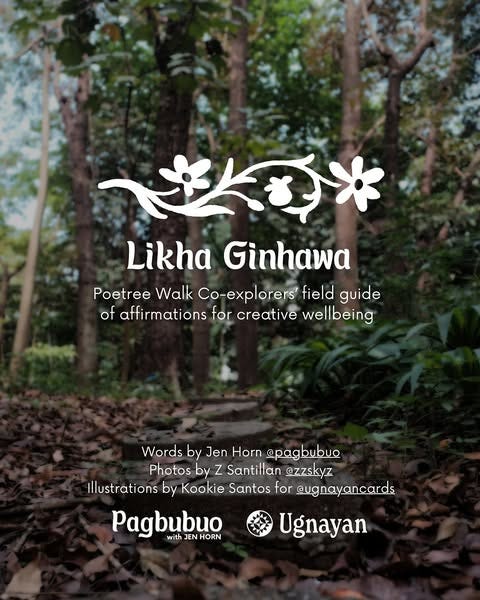
Below is a short guide a made for participants in a Poetree Walk I hosted last March. I find that the affirmations I listed are as applicable to art-making (the main intention of the guide) as they are to holding brave and emergent spaces.
5. Presence is poetry.
Artful facilitation requires presence. To set aside judgment and other distractions and to really activate our senses to be with our participants in the here and now. And while this is a key lesson, I do not mean to say it’s something I’ve already mastered. It’s a constant practice and balance; to develop in one’s self the habit of being fully present, while also being mindful of where the group needs to go.
I never realized how truly listening is hard af, until I stepped foot into the coaching universe. It was heightened further when I learned about awareness-based systems research and social arts from Presencing Institute, where we hone a practice of seeing the group as a whole, and not just the individual participants. It really is a skill we need to continually nurture, and it’s so important to a grounded, connected and meaningful facilitation practice.
III. Pagbuburo
Making intentional space for reflection has nourished my facilitation practice — debriefs on what worked, what didn’t, what we could do better next time. And more than just the default self-criticism or seeking constructive feedback from others while quickly forgetting their praise, its helped me to reflect on what I appreciate about myself, how I showed up, the participants, the space, the opportunity.
6. Walang sayang
Whatever happens, everything is compost.
There may have been programs or workshops I ran that I didn’t run to the best of ability, whether I lacked preparation or support. There are times when poor planning or communication with the requesting party didn’t set me up for a successful engagement. I’ve facilitated for a wide variety of audiences on a range of different topics, and they are all opportunities to feed my practice and continuously tune my instrument of facilitation when I take the intentional time to reflect on those experiences, and apply lessons intentionally to my future practice.
That was a lot, so I’ll end the insights there for now. And if you’ve made it this far down my post, I assume you move through some spaces as a space holder as well. And so allow me to leave you a few questions for your pagbubungkal and pagbibinhi.
What mindsets and beliefs need to shift or change in your space-holding practice?
What control do you need to loosen your grip on?
What could your practice look like if you gave yourself a bit more trust?
What affirmations can give you more courage to trust yourself and your participants?
Before I go, if you feel like you could use some tools or community support at this point, check out some of these upcoming gatherings that I’ll be facilitating:
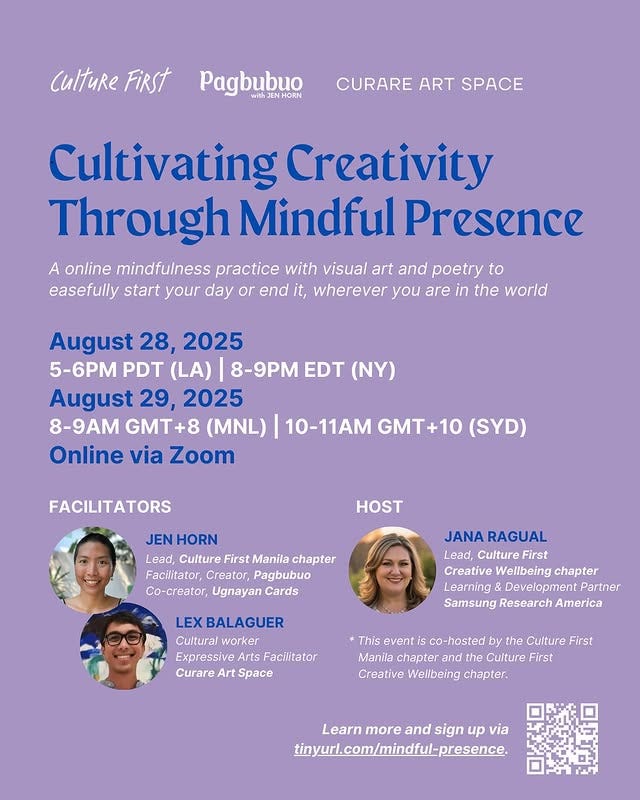
August 29, 8-9AM GMT+8 via Zoom | Cultivating Creativity Through Mindful Presence (hosting & facilitating)
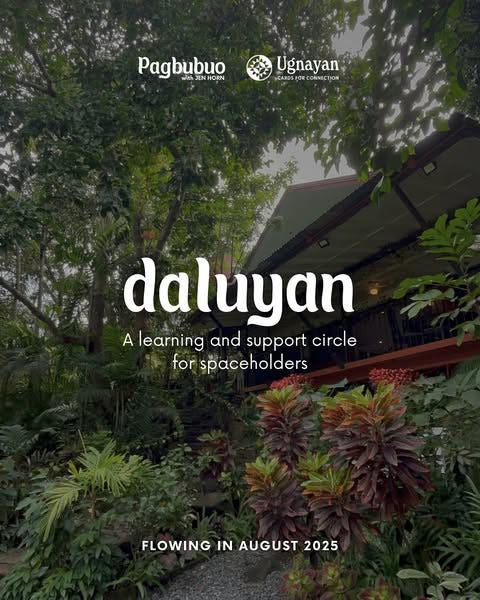
September 13, 9AM-5PM at Bahay Ugnayan, Antipolo | Daluyan: A learning and support circle for space holders - sign-ups until August 31 only! (hosting & facilitating)
September 26 at Samsung Hall, SM Aura, Taguig | [International Design Conference] Holding the whole: Designing for collective flourishing - details TBD (facilitating AM sessions)
October 25 | Hapag Ugnayan Potlucks - details TBD (hosting & facilitating)
Until the next thought snacks!
Power and joy,
Jen Horn | @pagbubuo
Learn more about Theory U here: presencing.org/theoryu

Learn more about coaching and my “flourishing framework” here: jen-horn.com/coaching