
Commodifying Creativity vs. Allowing Creative Ripening
Wag tayo sa kalburo. How might we re-orient ourselves with our creative process and resist the impositions of a fast-paced and often market-driven production?

Note: I made a disclaimer in my last post about the changing flavor of my Pagbubuo Substack posts. If you’ve been following my work, you’ll know I’ve stepped into the food space more and more in the past couple of years.
As such, I’ve decided to create Halina sa Hapag Ugnayan — a new Substack home for food-related reflections (though I’m sure I’ll still have food-related reflections here too). I intend to lay the tablescapes for a literary (rather than literal) potluck of food, creativity, community and connection over there — hopefully with contributions from others in the growing Hapag Ugnayan barkada.
At the same time, I intend to retain this Pagbubuo with Jen Horn Substack for more of my personal sense-making or whole-making as I weave lessons from the different spaces I’m in; as I ferment ideas about the world and ideas for my creative projects. Thank you for being here (and there)!
I also share some upcoming events at the end of this post!
I often find myself back here, disappointed that I haven’t moved swifter with my writing.
But whose timeline am I chasing?
What am I actually disappointed by?
Am I disappointed that I was slow?
Or that I didn’t honor a ritual of reflection and creative expression?
When I think about it, I realize that my disappointment is not in my slowness, but in the faltering in my devotion to my Self1, my creativity and contribution.
Decommodify creativity; re-gift it
While author and botanist Robin Wall Kimmerer spoke more about the gifts of the earth (rather than the gift of creativity) in a podcast I recently listened to2 , I relate what she said to creativity too:
[There] is difference between a commodity and a gift, because a commodity is really just a thing, it’s an object. But when we move to the notion that the food that we eat, the air that we breathe, that wonderful drink of cold water, is a gift from Mother Earth, there’s so much intention there. You feel like, for me? That gift is for me. It comes with relationship […] a reciprocal relationship, where in return for those gifts, […] what do we want to do? We want to say thank you. […] It re-enchants the world, and it becomes full of relationship, not full of things.
When I speak of decommodifying creativity, I do not mean giving away creative labor for free, especially when there is an unbridled capitalist at the other end of the transaction. I simply mean taking opportunities to reclaim it as a gift to give and receive with gratitude, removed of the chains of market-driven mechanisms, social media algorithms and false notion of enoughness.
I say gratitude and gift because:
Creativity is a gift, one that we all have inside of us in one form or another, without us asking for it or deserving it. However, we often suppress by thinking that we need to show up in the world a certain way — a way that leaves us with little room to express our creativity.
When we are given a gift, we show our gratitude by recognizing the beauty of the gift, using it, and reciprocating the gesture by giving back or paying it forward in some way. To keep it to ourselves does not honor the gift or the giver.
I do not have any devotion to a particular deity or any “Giver”, but I see creativity as an act of devotion and faith, and I honor the gifts from nature, my body — gifts I did not earn but received anyway. My Givers are not of one face or name, but I am grateful to them.
I do not say these as banal platitudes or as words of wisdom. Rather, I write these for myself as much as (or perhaps more so than) for you who read this — as a reminder to give myself grace in creating.
As we move closer to the midpoint of the year, I remind myself of three beliefs or mindsets I set for myself at the start of the year (and some of which I’ve already held) to guide, anchor and root me as I go about creating and offering gifts back:
Iwasan ang kalburo.
Magtiwala sa daloy.
Walang sayang.
I will share my reflections on these in three separate posts, and I start with the first belief / mindset / philosophy here.
Iwasan ang kalburo.
Hayaan natin ang dahan-dahang paghinog.

Kalburo is a Filipino term for calcium carbide, a a greyish-black, rock-like industrial chemical compound used to artificially ripen fruits like mangoes, bananas, and lemons, forcing them to turn from green to yellow. When exposed to moisture, it produces acetylene gas, which mimics natural ripening agents. But it is hazardous, causing skin burns and potential health risks to the farmers who process fruits this way, and the consumers who buy the force-ripened fruits.3
To force-ripen is a detriment to both the consumer and the creator, primarily serving a capitalist interest to earn more profit in a shorter period of time.
It reduces the value of a product or commodity to how much more one can churn out within a given time frame. It doesn’t factor in the personal, social and ecological benefits of letting nature’s processes unfold as they should — the sweeter taste of mangoes, the mindful savoring of the fruit of our patience, etc. Neither does it factor the costs of a hastened process — the health and wellbeing of farmer and eater, the unnecessary production of synthetic industrial calcium carbide, etc.
What if we run our creative practice and our lives with a different system in mind?
I believe that our homes, our workplaces, our personal creative practices are fractals4 of the wider world. And even when the systems in place in larger society seem intractable, I believe that asserting our agency and exercising small acts of collective resistance in those spaces can shift culture, and eventually, I hope, shift structure and design too.
I created the table to below to illustrate my developing thoughts around it.
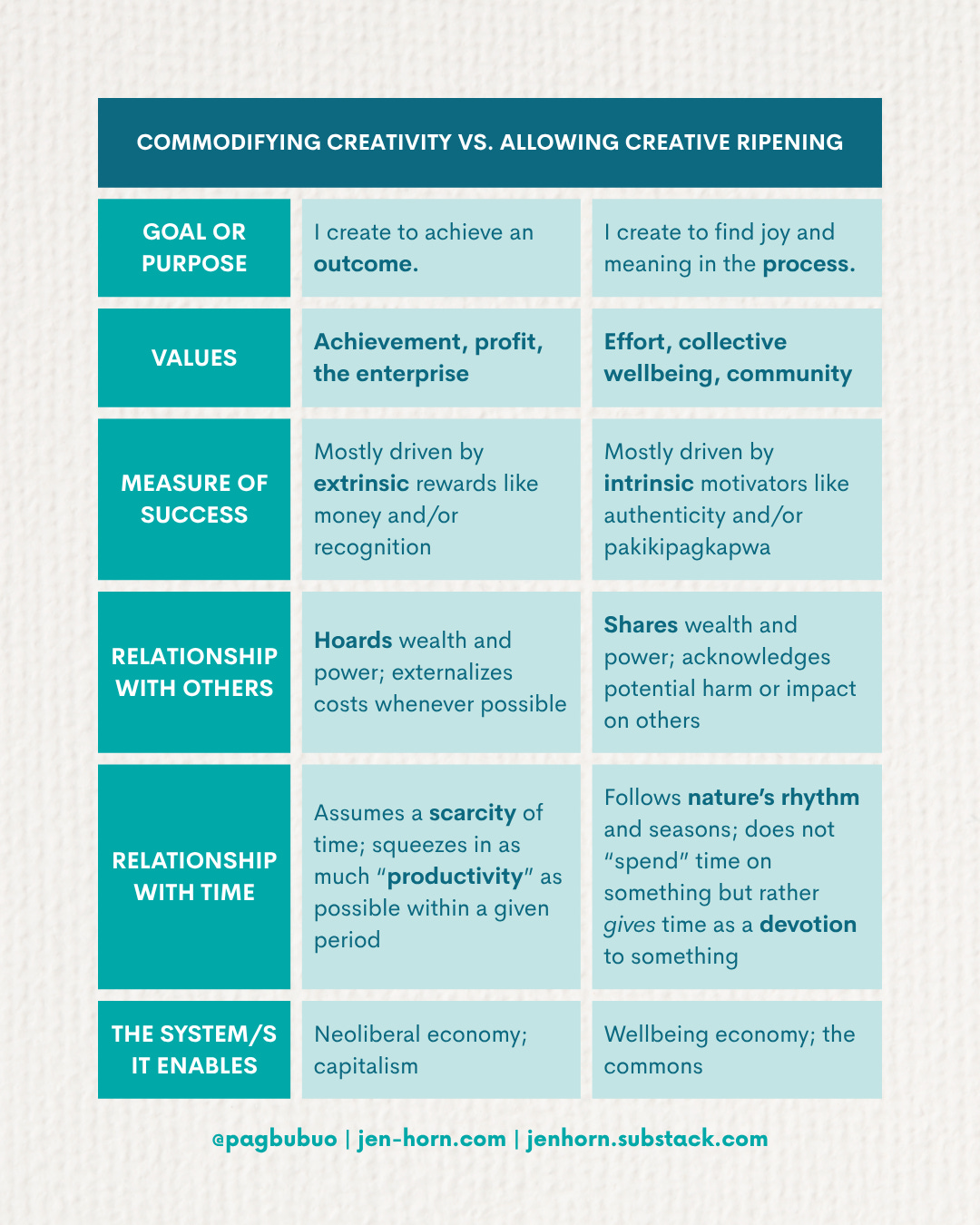
As with most of my writing on this Substack, these thoughts are works-in-progress, as I’m a work-in-progress. I’d love to know what resonates and what doesn’t for you from the table above.
Giving ourselves and our projects time
Nature has its own sense of time. And those living in right relationship with it flow with its rhythm.5
I’ve spoken openly to friends and people at meetups or gatherings that I’ve been wanting to create a food-themed deck for Ugnayan. I’ve dreamed of it since we came out with our first deck in 2023. Eventually, we’ll make that deck, I told myself. Fast forward to 2025, I thought we would come out with it before the end of the year, and I’d rushed to create some working prototype by October, but it was clearly very hilaw.
At the start of 2026, I thought we would come out with something by October this year, but by April, I already knew it wouldn’t be ready by then. Not in the form it is evolving into right now. Not in the process by which we’d like to bring it into this world (like a water birth vs. a C-section). And not without sacrificing the ginhawa ng mga tagalikha (wellbeing of the creators). It’s not time.
At certain points, I’d wonder, am I overthinking it? Am I making it more complicated than it needs to be? But something inside me knows that I am not making it more complex as a “performance” or for ambition. I am simply acknowledging that it is more complex, because its intention is also more complex. (And I’ll share more about it bit by bit in the coming months.)
There is an intentional co-created quality that I hope for it. And co-creation requires relationship-building, which adds friction in a creative process, but to me, this also adds meaning and intention to what its natural ripening will yield.
And while I continue to nurture that fruit tree, I tend to other parts of my creative garden that will nourish me — other smaller creative projects and devotions to my creative self. This will sustain me while nourishing the soil and ecosystem where my fruit tree continues to grow.
We are still embedded in the systems we are in, but resisting the commodification of creativity means finding the cracks and spaces to decommodify it. To reclaim our autonomy and sovereignty to create on our own terms — unencumbered by a system that sees us machines or production lines; inspired to offer a gift for the wellbeing of the whole.
I leave you with these provocations for further reflection:
What if we allowed the fruits that take longer to grow the time that they actually need?
What would it cost the consumer and the creator to rush this creative process?
What other sources of nourishment might we find in the meantime? What will continue to sustain us while we wait for its ripening?
How much sweeter might the harvest be if we tended to its growth and ripening with patience instead of hurry, and humility instead of arrogance?
‘Til the next thought harvest,
Jen Horn | @pagbubuo
Some upcoming gatherings
May 30, 3-5PM - Sikodiwa Book Talk @ Fully Booked BGC
- I’m moderating/hosting!
With my interest in Sikolohiyang Pilipino and the depth and meaning of our own language, I’m looking forward to hosting this conversation with Carl Cervantes of Sikodiwa on his internationally published book. Join us this Saturday by signing up via bit.ly/fbevents2026.
June 12-14 - Gulay Pa More Sagada
- I’m joining!
I joined Gulay Pa More Sagada last year and had a great experience then, and so, I’m joining again this year! We listened to stories from farmers, cooks and advocates, foraged for mushrooms, discovered local ingredients at the Sagada market, went on a coffee trail, and cooked and feasted with a like-minded community of lovers of veggies, culture and connecting over food! If you’re interested in a meaningful and grounded learning experience on gulay like me, come join the fun! Learn more and sign up via tinyurl.com/gpms2.
Self with a capital S, as in the Self in Internal Family Systems (IFS) therapy — our calm, compassionate, curious and centered inner presence, core essence of who we are when free of judgment, burdens, or emotional wounds.
Listen to more of Robin Wall Kimmerer’s gifts of thought about reciprocity and the living world on the Sounds True podcast here.
Why do farmers do it in the first place? Often to meet a market demand for yellow and blemish-free fruits. In Benguet, Rural Rising found that many farmers struggle to sell green lemons because the market is used to the yellow lemons we often import from China.
What are its potential impacts on consumers? According to this article on Hindustan Times, it can cause symptoms such as “headache, dizziness, mood disturbances, and in severe cases, neurological damage due to arsenic and phosphorus residues”. As far back as 2015, in an article published by Sunstar, Bacolod City Councilor Carlos Jose Lopez proposed an ordinance to prohibit the use of calcium carbide as fruit-ripening agent to protect consumers. He cited that Philippine Constitution’s Article II, Section 15 provides that “The state shall protect and promote the right to health of the people and instill health consciousness among them.”
I first learned the term fractals from my homegirl adrienne maree brown in her book Emergent Strategy. In essence, fractals mean that the micro reflects the macro. Patterns of the universe repeat at every scale, and so, how we practice and behave in our small, personal interactions creates the structure, framework or scaffolding for systemic change.
I wrote some reflections on time in a post last year, our language and (capitalist) constructs around it. Read it here:

needed this sm jen, thank you! (me resisting the slowness of duma life and forcing myself to be as productive as i was in manila hahaha)
Loved reading this!
I love your framing of "creative ripening" and "giving time as devotion."
Coincidentally, I have also been thinking about time in relation to creativity... Lately I have been experimenting with "making" time by separating activities that have become bundled into one device through modern technology (i.e., a smartphone) into slower tasks/journeys of inquiry. For example, I tried giving up the "smart" features of my phone for a day. Using it only to make and receive calls and texts (no social media or googling). One realisation I had (amongst many) was that this meant I would have to sit with questions for longer and seek help (go the long way) to find answers. Instead of googling the answer, I had to ask people, maybe look it up in a book etc. Contrary to the expectation that this would end up with "wasted" or lost time, I found this experiment expanded my sense of time and spaciousness in the day. Anyway, all this to say, your post really resonated! Thank you for sharing your thought harvest <3