

Note: There was so much sloshing around in my head leading up to, during and after the International Design Conference (IDC) on Holding The Whole: Designing for Collective Flourishing by DTI-Design Center of the Philippines (DCP) last September 26, back-to-back with our more intimate Ugnayan tambayan at the Likha Library by @karalso_ on September 27.
While I could probably sit with those thoughts and emotions more, there is a conversation between these two events that just needs to happen in my head already — whether or not it is “complete”.
This post will be riddled with many personal thoughts and feelings, so if you’re looking for a more pared down or put together post, this is not it. It will be long. Step in, if you’re curious enough.
I don’t know where to begin. So I’ll just start.
Know that there will likely be some suggested reflection prompts and pathways forward at the end of the post. 😉
Holding The Whole: Designing for Collective Flourishing with DTI-Design Center of the Philippines
I. The Invitation
When I received the invitation to facilitate a segment of this year’s International Design Conference themed Holding The Whole: Designing for Collective Flourishing, I felt really kilig because the theme really spoke to me.
It almost felt like the organizers added my Pagbubuo meanderings + the writing of authors, facilitators, community organizers and activists whose work I resonate with (the late Joanna Macy, adrienne maree brown, Céline Semaan Vernon of Slow Factory, Ida Persson of DesignShifts, @willowonearth of Atmos, Robin Wall Kimmerer, All We Can Save’s Ayana Elizabeth Johnson and Katharine Wilkinson, the late Jane Goodall, etc. etc.) and plugged it into some AI thing and asked it to craft a conference concept and invitation especially for me:
This year’s IDC is grounded in a call to transition from design as problem-solving to design as the stage of and guide to transformation. Inspired by movements that center flourishing over growth, care over control, and purpose over productivity, we explore how design can activate a future anchored in human dignity, ecological harmony, and shared transformation.
Moreover, the DCP team (special shoutout to Yumi, Raissa, Nikki and Gilda) in collaboration with experience designer Abi Mapua designed the conference in three segments: Break, Make and Become, which sat really well with my love for nature’s language of decay, growth and evolution. I especially loved that I had the role of opening with the Break segment.

There’s so much more I could say about the care I genuinely felt went into crafting this experience, and the hope I had in what could come out of it.
II. The Facilitation and Agitation
IDC was going to be my biggest platform for facilitation at that point, with a capacity of up to 600 participants from different sectors.
I was especially tickled by the fact that I was invited to a conference of such scale and be asked to facilitate reflection. How refreshingly unconventional!
I had always hoped organizers did more with large scale conferences — not just constantly download information unto the audience, but to make it more interactive, allow space for their insights to emerge, and foster connection among attendees — and here was my chance.
The language and intention of the conference was so close to my heart, and I had a lot of concerns on whether I would do it justice, and if what needed to emerge would emerge — especially around the recent events on September 21.
In the days leading up to the conference, I felt more and more nervous and anxious. With the following thoughts cycling through my mind:
I’m “just” a facilitator and moderator and not a keynote, why am I so nervous?
I’m nervous -- because this topic and platform are important to me. And I don’t want this to be just another conference.
I’m not here to perform. I’m here to be human, imperfect and whole.
Talking to my fellow moderator Nikki Carsi-Cruz on the phone the day before helped ease my nerves, and watching her masterfully weave the afternoon conversations at IDC again this year felt like a validation of the important work of space-holding.
I can even say that I was looking forward to the conference less so for the speakers or panelists (not to say their voices were less valuable) and more so to watch Nikki moderate — all without notes, a phone or an iPad (which perhaps I used too much as an emotional support tool even if I probably didn’t need it as much as I thought haha).
I’m not here to perform. I’m here to be human, imperfect and whole.
III. The Reflection
As I wrote in a previous post, facilitation requires a lot of trust - in one’s self, in one’s participants, and in an emergent process. I’m grateful that IDC attendees participated in the Menti, through Q&A, through post-it reflections, allowing for some things to emerge for themselves, and for us on the stage as well. Here’s some of what I’ve left the conference remembering:
It was clear that many attendees had corruption in mind (Menti as proof), with some feeling sadness and anger with the injustice of the Mendiola violence and arrests, which Bella Tanjutco bravely brought up in response to a question that came through the Q&A online.
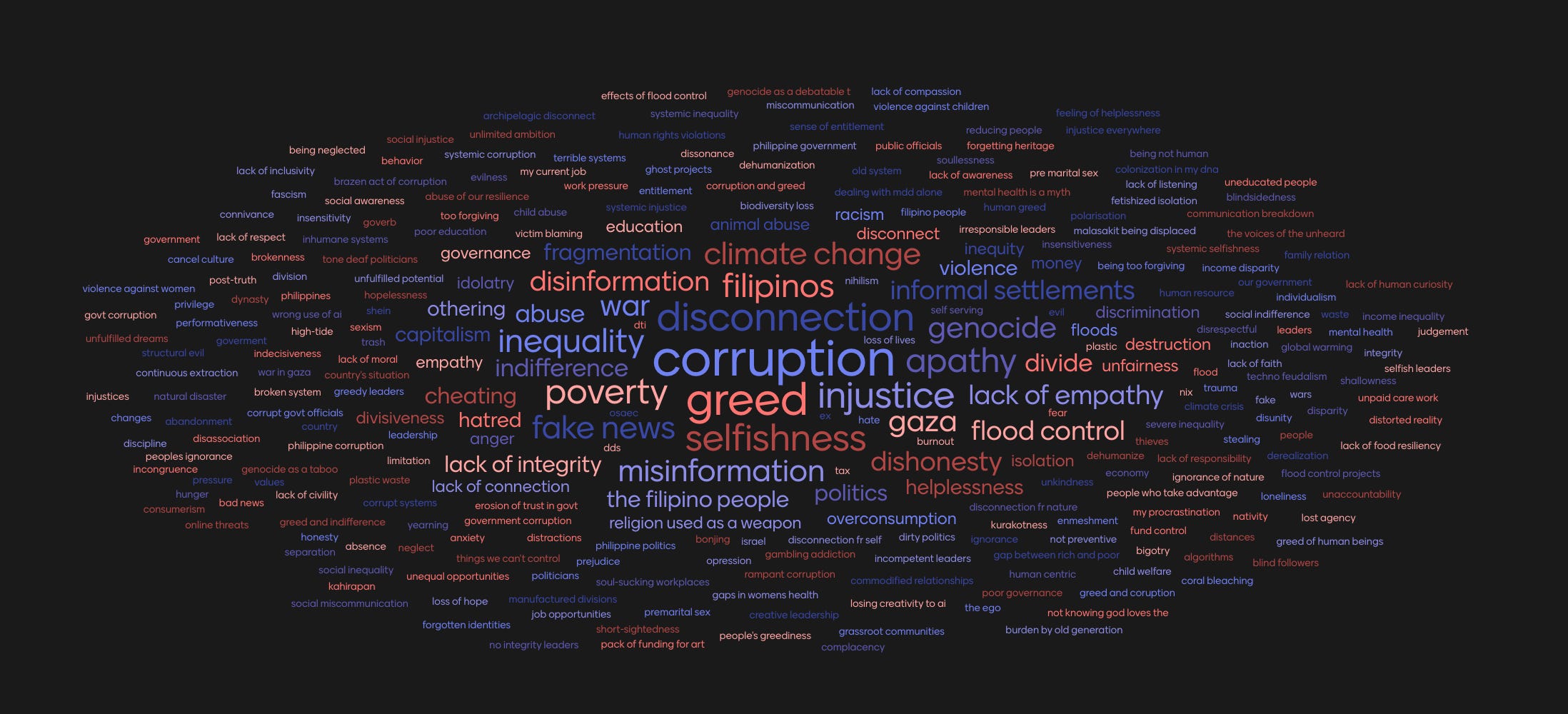
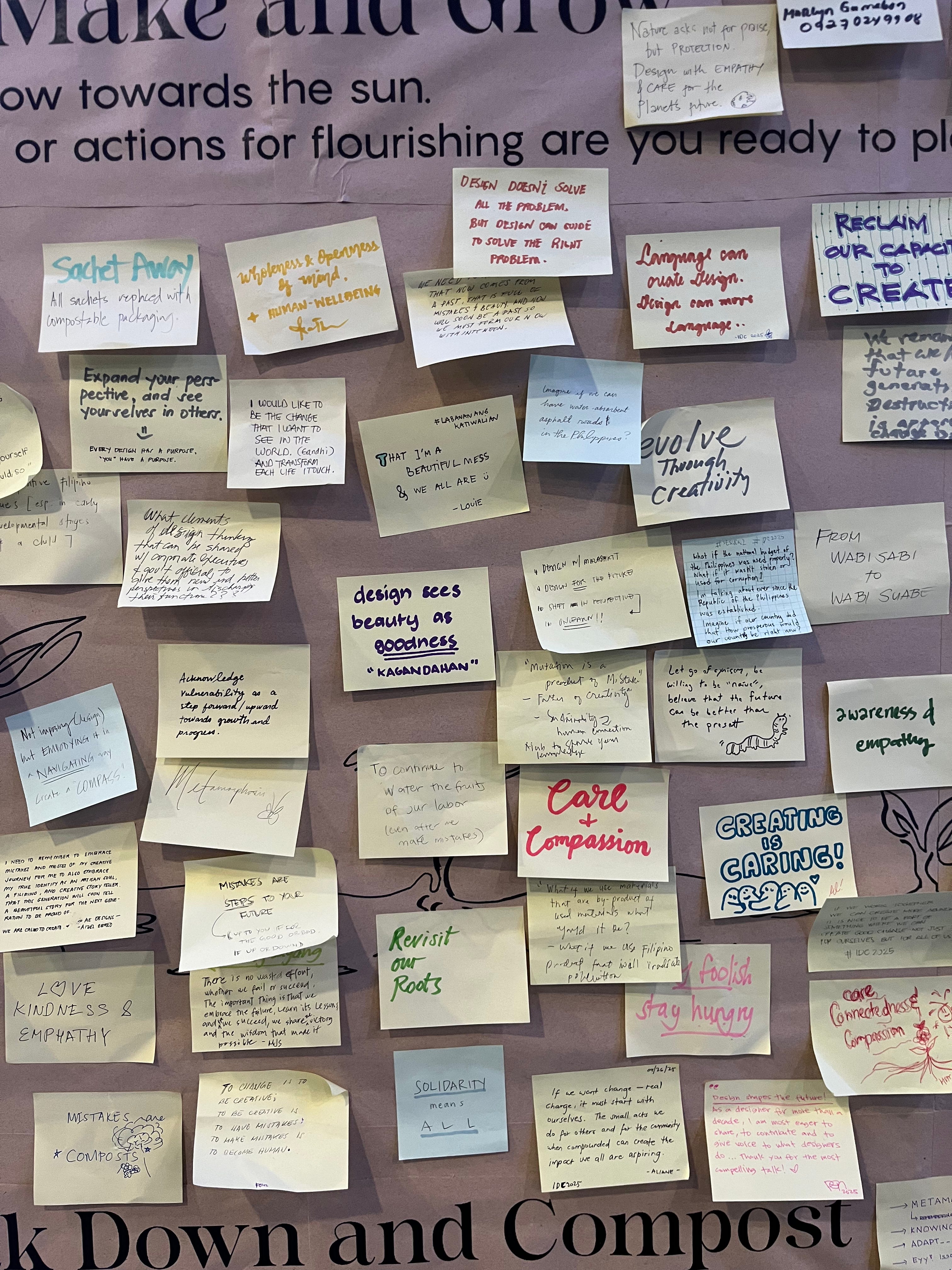
It was also clear from the Menti and some of the post-it reflections that compassion, empathy (both of which could be related to malasakit), collaboration and a systems perspective were among the key shifts that the audience felt what necessary in order for us to design for collective flourishing.
I’d also known Raf Dionisio for a while in the social enterprise space, but never really got a chance to hear him share MAD Travel stories. I appreciated the stories he shared during the Make session about how he was humbled and taught by the communities they work with when:
A community leader sought seeds instead of money (because the seeds can grow and feed more)
Asked if he hoped that all the youth in their community be able to pursue education in the city, a community leader sought that opportunity for only half, so that some could learn how to take care of the land
Raf shared about the time it takes to cultivate relationships for meaningful making and co-creation, and we hardly factor that in our processes
Finally, I really appreciated Nikki Carsi-Cruz’s provocation to the audience about how we might think about the keynote speaker Joe Pine’s talk in the context of the Philippines, and how, when we think of collective flourishing: how might we ensure that transformative experiences are designed by, for and with those at the margins, and not just concentrated to an elite few?
I think by the time Nikki got to that point, I was really thinking about Kar Abola’s maka-kapwang ginhawa framework, which in my mind, aligns with collective flourishing (though translations don’t quite capture the nuanced definitions of things).
* I haven’t had the courage to watch myself in the recordings yet, but if you were interested to see what you missed out on, you can watch the recordings of the conference segments: Break, Make and Become on DCP’s Facebook page.
Designing Maka-kapwang Ginhawa with Karina Abola
Still recovering my extroversion energy and swimming in the reflections of IDC, I had a beautiful space to compost more of those thoughts the following day.
It was the Likha Library pop-up at __63 at Comuna, Makati, created by one of my favorite humans, Karina Abola (@karabola__).
My Ugnayan Cards co-creator Kookie Santos and I hosted a little tambay called Ugnayan at Likhaan, where we opened a space for creatives to reflect on what is maginhawa and di maginhawa in their creative practice — with responses ranging from the ginhawa ng taga-likha to ginhawa ng lahat, towards maka-kapwang ginhawa.
In a world in decay and disillusion, we believe in the power of connection, curiosity and creativity to bring us towards “maka-kapwang ginhawa” — ginhawa that is rooted in dignity, freedom and justice.
As I did at IDC, I invited participants to try three practices or archetypes for the day:
Buksan ang tenga. Open your ears.
This is to come in with presence. To be like a facilitator, or tagapagpadaloy, with the space-holding capacity to really listen. To give each other the respect and dignity of being heard and understood. This is where malasakit begins.
Buksan ang isip. Open your mind.
To come in with humility and a search for truth. To be like a researcher, or mananaliksik, who asks questions that shift or expand perspectives. To question our assumptions, the gaps in justice in this world, and the pathways of hope. This is where transformation begins.
Buksan ang puso. Open your heart.
This is to come in with audacity and trust. To be like an artist, or manlilikha, who, with a broken open heart, reimagines what could be, brings into existence something that wasn’t there before, and alchemizes change. By freely expressing our truth, we open up more space for others to do the same. This is where revolution begins.
Everyday we are alive, we have the capacity to create. And to create is an audacious act. It can serve or subvert the status quo, which means we have a direct hand in shaping the world based on the values that guide our creation.
There were discussion about tight deadlines, the toxic clients or workplace, the designing for capital like we are machines and not humans, design ethics and integrity, and feeling like we’re trapped to design in a system that is not of our own choosing or design.
But creatives are alchemists. We can transform ourselves, our practice and the spaces we move in. Maybe not drastically or immediately, but everyday, we have choices and opportunities to say yes towards what we want to co-create, and a hell no to what needs to be broken.
Here are some provocations we had there that can guide your own practice of creative living:
What intention guides our creative practice?
What does it say about our values and the kind of world we want to bring into existence?
If design is a “kilusan” (movement), what do we want to move towards together?
What questions should we keep asking ourselves to cultivate a creative practice that is maginhawa (allows for wellbeing and flourishing) for us as creators and those we create for and with?
I’m grateful for this space she opened up for a community of creatives to reflect on our creative practice towards ginhawa, and for the world to now see her creation and act of resistance too. Read more about her research on Designing Ginhawa through her Pamphlets on Design.
Connect with creative communities
There’s more thoughts and feelings where all this came from, but I’ll end this post with a call to connect with a community to practice design and creativity towards maka-kapwang ginhawa, wherever you might find it.
Here are a few things that are coming up that you might connect with:
Towards Ginhawa
DTI-Design Center of the Philippines is hosting Design Week Philippines themed Towards Ginhawa, happening from October 11-18, 2025, with various gatherings hosted by different creative communities across the country.
Join me and my Ugnayan Cards co-creator Kookie Santos at different opening activities on October 11 at the Power Mac Spotlight Blackbox Theater at Circuit Makati! Sign up via https://tally.so/r/wMWvZA.
Folio Review from 1:30-4PM with Kookie and other creative lodis
Redesigning the Workplace from 4-5:30PM with me and my panel of workplace reimaginers and redesigners 😊
Kar will also be part of a talk and workshop on designing ginhawa as part of the culminating activities at Ayala Triangle Gardens on October 18.
Luto Likha Linang: A Hapag Ugnayan potluck of food and creativity
Hapag Ugnayan is an evolving project that began with a desire to bring people together around the table for connection with land, food, identity, creativity and kapwa. A grant we received from British Council’s Connections Through Culture (CTC) programme last year has allowed me to go on visits to women farmers in General Nakar, Quezon and Lupang Ramos in Dasmariñas, Cavite, so we can learn more about their stories and be in solidarity with them.
This October 25, my friend Mabi (of Good Food Community) and I are bringing together 25 women creatives, along with 6 farmers from our CTC visits, and creative collaborators from The Arts and Health Institute, Rural Women Advocates, TKTK Feminist Printmakers and Ugnayan Cards for a full day creation, joy and resistance!
Click through the Instagram post to learn more, and express your interest to join via tinyurl.com/lutolikhalinang. Sign-ups close on October 19, 2025 or while slots last.
Dami kong sinabi. Tigil na ako. 😅 Magkita nalang tayo sa isang ganap?
Casting spells,
Jen Horn | @pagbubuo