
Cooking as Creative Act: Shifting attitudes on the quotidian chore of life
What if the everyday act of cooking could offer pathways to wellbeing beyond its nutritional value? What if it could be a form of creative expression, resistance, and a builder of social connection?

If you started subscribing to my Substack 2+ years ago because of my content on positive psychology, psychological safety, organizational culture, leadership and team development, you may find the topics of my more recent posts taking on a different flavor profile. My work is changing and my thoughts are evolving, and if you find that this is no longer what you came here for, I’ll be sad to see you go. I think if you stick around a little longer, you might find that everything is still connected, but I’m just lending different perspectives and language to that. Stay to see where this goes? 😊
Hi there!
I hope you had a moment to enjoy the quiet from Holy Week. For me, I spent it mostly preoccupied with food and cooking — from the food cards / deck we’re cooking up for Ugnayan, to my next fermentation project (sourdough na ba or yogurt muna?), the kitchen experiments with sourdough discard, a fair attempt at a chicken tikka masala, my Anak ng Bucha! kombucha-making workshop on April 9, the expected but still surprising surge in prices everything — including LPG tanks (will rethink the attempt at sourdough bread), and contemplating a possible Salad Start! salad-making workshop on May 1 (if there’s interest and energy?), etc.
I also spent a good part of my Easter weekend snacking on three different Filipino food-related books (reading in parts) and some journal articles on the psychosocial and anthropological significance of cooking and eating. Nakakagutom at nakakabusog sa kaalaman!
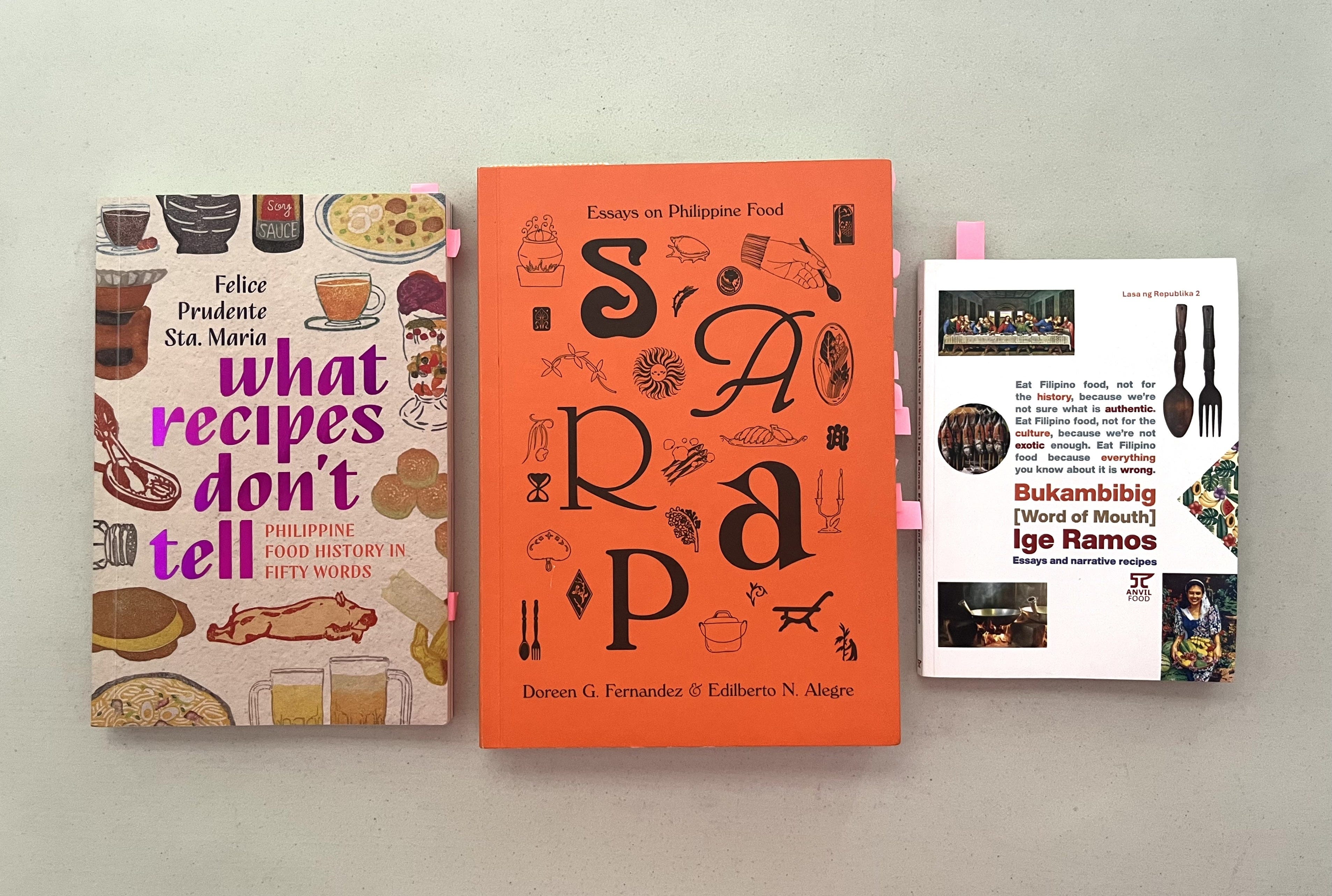
Thankfully, these books come in formats that are bite-sized — short paragraphs or essays that allow me to nibble on what I feel like without committing to full servings. 😅 This allows me to discover both the common and distinct flavors of each of these books or authors, and assemble the pulutan that makes sense together to me. It’s giving girl dinner but for books / research!
All this was happening while I continued to chew on the metaphor of fermentation and culture-building in all its forms.

I’ll share some of what I’m learning so far, but I’m not anywhere close to done in my learning. There’s still much to explore! I break down my writing here in three parts:
Namnam: Language and the cultural significance of food
Lutu-lutuan: Playing with food as expressive art
Anong pagkain? Relational wellbeing and gender roles in the kitchen
Namnam: Language and the cultural significance of food
We create words for what we need to talk about, and what is not in our vocabulary is not in our lives
DOREEN G. FERNANDEZ
If you’ve been following my writing or work (especially with Ugnayan) for a while now, you’ll know that I have a fondness for Filipino words and meanings they convey. And even if you haven’t been following me for a while, calling this Substack publication and my Instagram “Pagbubuo” and introducing myself as a “tagapagpadaloy” also make this love for Filipino words pretty obvious.
Ninanamnam ko yung mga salita.
I savor the words.
Namnam
v. to savor; prolongation of the enjoyment of taste in the mouth
…as documented by lexicographer, linguist and former director of the Institute of National Language Jose Villa Panganiban (JVP).
In referencing JVP, Felice Prudente Sta. Maria goes on to say:
While taste is the sensation of flavor, savor adds the dimension of “enjoying food or an experience slowly in order to appreciate it as much as possible”.
What if we took more time to relish the taste of the food before us, the journey it’s been on, and the hands it passed through before it got to our plate?
In that same line of thinking:
What if we were more curious about the words we use and the scenes in which they came to be?
What if we noticed the patterns in our language and imagined what they must have meant to our culture?
We have so many different names for rice without just resorting to “rice” and this tells us with certainty that “rice is life” for Filipinos. To briefly illustrate:
Unmilled rice = Palay
Milled rice = Bigas
Cooked rice = Kanin
Rice porridge = Lugaw
Burnt rice at the bottom of the pot = Tutong
Day old rice = Bahaw
Fried rice = Sinangag
There is a completely different word for each state or condition of rice, unlike in English where it’s rice + a series of adjectives or descriptors. And this barely scratches the surface, because apparently, we have 160 words in reference to rice!1
How interesting it is to unpack the language and the relationship we have with these words, our ingredients, our foodways and what they tell us about what we value as a culture. So, repeal the Rice Liberalization Law.2
Lutu-lutuan: Playing with food as expressive art
Cooking is the creative act of producing a food combination which does not exist in nature. There are no daing, tapa, buro, inihaw, nilaga, sinaing, etc. in nature. These are not natural states; rather, they are man-made. Man intervenes and produces a new combination. The cook is thus a creator.
EDILBERTO N. ALEGRE
When I signed up for an expressive arts facilitation course with The Arts & Health Institute (TAHI) in 2024, I was already marinating ideas for how food might be integrated with a facilitation practice most commonly associated with visual arts, music, movement and drama.
And while that idea wasn’t cooked through in time for my final presentation before graduation, I’ve since hosted Luto Likha Linang and subsequent Hapag Ugnayan gatherings that blend food and creativity, and I’m experimenting with other ideas through workshops that involve creating in the kitchen while connecting with one’s self and fellow kitchen alchemists or artists.
Indeed, cooking offers us opportunities to express ourselves creatively3 by:
Exploring new foods and flavor profiles
Seeing how different ingredients work together
Preparing meals despite constraints
Assembling visually pleasing dishes
Recreating meals eaten outside
With more and more people getting into “crafting” and creative activities that invite us to slow down, cooking also becomes a form of resistance to the culture of convenience, expedience and commodification that capitalism has peddled.
And it’s not about making a Michelin-worthy meal, employing the fanciest imported ingredients, or perfecting a complicated cooking technique. It’s just about the joy of creating something from scratch. It’s about making a mess. It’s about fucking up, having a laugh about it, and deciding that even it’s not as you had hoped, it’s edible enough to feed you (hopefully). As we like to say at TAHI: All art is good art.
So the point is just to go to your kitchen and play! Laro-laro lang!
I think food prep is like being a scientist or a witch or an alchemist!4 Name it what you want to, and run with it.
There is much joy in discovering I can do things. I recently tried making greek yogurt, and I’m still deciding if it was worth the effort. If I do the math, it doesn’t seem to be “worth it”, but it was a joyful, nerdy and satisfying thing to do nonetheless!
So, I wonder, for you:
What kitchen experiments or creations will bring you a joyful experience?
What messes and mistakes are you willing to make?
Who might you invite to play with you in the kitchen?
Anong pagkain? Relational wellbeing and gender roles in the kitchen
Nayanaya
To entertain or feast the guest, showing him good will and that one is delighted (or has pleasure) in receiving him.
Ancestors did not only enjoy eating, but feeding others. Eating and feeding blended into a recipe for all-around happiness. Nayanaya is pakikipagkapwa in action, sharing one’s humanity with others, and a revelation of kagandahang loob, one’s good and beautiful inner being.
FELICE PRUDENTE STA. MARIA
I’ve gone to two book talks of Felice Prudente Sta. Maria, and each time, she mentioned nayanaya. It’s a beautiful and romantic sentiment. I love it. I really do.
At the same time, I can’t help but wonder about two things:
The stress that comes with hosting
I’ve seen this often enough in my life when my mom hosts, and so I’ve also consciously tried to have my own chiller way of hosting (i.e. a tendency towards potlucks). Friends will still say, “Jen, umupo ka,” when I’m doing things in the kitchen, but I’d like to think it’s many levels below the constant worry and fussing my mom would engage in on the day, and in the weeks before hosting guests. 😅
The more quotidian task of feeding your family everyday
Hosting guests is a special occasion, but what about all the other times when it’s not exactly a thing you choose to do, but an expectation or obligation in your home? As a woman in a country that generally raises boys to be babies or señoritos, this burdens, no, vexes me. Because there is less autonomy or choice here, it can feel less rewarding or pleasurable and more stressful or burdensome.5
From that same journal article, some researchers suggest that quotidian moments embedded in our daily lives, like cooking, can also be opportunities for connecting with others. One of the central benefits of home cooking is exactly that it facilitates social connection.
I’ve been an advocate of bringing people back into the kitchen, and it’s been easier with friends or with the Good Food Community, but it remains challenging in my own household. (I live with two aging parents and my single eldest brother, mostly, and it was really challenging when our one household helper passed away last April. Thankfully, we have some help now.)
When without household help, no one else prepares meals or even tries or takes interest apart from me. And yet, thinking about how to change embedded patterns of behavior in my family is harder for me to do than encouraging strangers back into the kitchen.
Maybe stumbling upon this research — coupled with my Ugnayan and kitchen experiments — will inspire me to explore the possibility of different dynamics at home when I consider:
What are some current realities I need to accept? What are some current realities I need to resist? What agreements or boundaries can I set for my own wellbeing?
What perspectives, attitudes or behaviors might I change to make even obligatory cooking more pleasurable?
What are everyday tasks or activities that can invite micro-moments of connection in the kitchen?
I think there is a limit to how much joy we (or I) can get in the kitchen if I feel that I carry most of the responsibility for meal prep, while also still having my other work or responsibilities. Sadly, this sounds like a familiar refrain for many mothers juggling the unpaid care work and the paid work work. (And I’m not even a mother.)
So beyond the earlier questions, I’ve also had larger questions around:
How we raise boys in this country
How we might shift this uncalled for expectation on women
How men (boys) might take on more of the responsibility and mental load of care work in a household
My Instagram algorithm is so spot on in feeding me reels that make me feel less alone in this. 🙃 And there’s much more to say, pero baka ma-empacho na kayo. 😅
In the 4-5 days that it took me to write this post completely, it’s taken some turns I didn’t expect. I thought this third section was going to be mainly about the relational wellbeing effects of cooking, based on the article by Farmer and Cotter.
But I also needed to acknowledge the burden of women, and in a small way, resist it (by shifting my own perspectives, or by setting better boundaries), to keep myself sane, so that indeed, when I do feed others, I honor them and myself in the process.
Our ancestors liked feeding others, but they also enjoyed feasting too. There is what we give, and what we also receive in the process.
Sa paghahain ng pagkain para sa iba, paano rin natin napapabusog ang ating kaluluwa?
‘Til the next meal,
Jen Horn | @pagbubuo
In her essay, Historias, Cronicas, Vocabularios: Spanish Sources for Research in Philippine Food in the book Sarap, Doreen Gamboa Fernandez shares that out of the 713 food-related words listed in the 1754 Vocabularios de la lengua tagala by Juan de Noceda and Pedro de Sanlucar, 160 words pertained to the varieties of rice, or terms in planting, harvesting and cooking it! All the more reason to celebrate the diversity of all the kinds of rice we have in the Philippines, and to protect our local rice farmersss.
Seven years ago, when the Rice Liberalization Law was signed in February 2019, it promised to lower prices on rice for consumers, and boost local farmers’ productivity. The reality is that this law gave more advantages to large-scale importers and rice cartels, kept prices of rice up for consumers, while pushing purchase prices of palay or unhusked rice from farmers down. Prices for unmilled rice dropped to as low as 7-10 pesos per kilo in some areas. The removing of import quotas and introduction of tarrifs allowed unlimited private rice imports, crippling local farmers and their production. Rice prices have also stayed high for consumers, even when import tariffs were reduced.
To grow more rice self-sufficiency for our country and fight for the dignity for farmers, we can support the Rice Industry Sustainable Development Act or RISDA which calls for a guaranteed procurement price, a “parity clause” where importers must buy a certain amount of local rice for every ton they import, and we need to call for transparency and efficiency in the implementation of the 30B Rice Competitiveness Enhancement Fund.
There’s a whole argument for the wellbeing benefits of cooking, as posited by Nicole Farmer (and how is that her surname is so cool too?). See the complete reference here: Farmer, N., & Cotter, E. W. (2021). Well-Being and Cooking Behavior: Using the Positive Emotion, Engagement, Relationships, Meaning, and Accomplishment (PERMA) Model as a Theoretical Framework. Frontiers in Psychology. April 2021, Vol. 12, pp.1–12. https://doi.org/10.3389/fpsyg.2021.560583 …uhhh yes??
One series I also really love is Lessons in Chemistry! While I don’t share the same experimental rigor as Elizabeth Zott, I enjoy seeing my fermentation experiments in bubbly action!
Most other insights in this section can be found in Farmer and Cotter’s article in footnote #3.